
Fewer Storms, Not Less Risk: What Your Organisation Can Actually Do This Hurricane Season
Fewer Storms, Not Less Risk: What Your Organisation Can Actually Do This Hurricane Season The most dangerous forecast is a

Fewer Storms, Not Less Risk: What Your Organisation Can Actually Do This Hurricane Season The most dangerous forecast is a

Privacy policies represent a structural failure of informed consent. They are far too long, excessively opaque, and seldom updated in ways that genuinely reflect real change or increased clarity for users.

Effective knowledge management for independent professionals does not require expensive software or complex databases. It requires a consistent system built on three principles: structured directories, redundant storage, and portfolio-ready organisation.
Research across Caribbean Small Island Developing States (SIDS) shows that project delays average 73% longer than originally planned. Here’s what
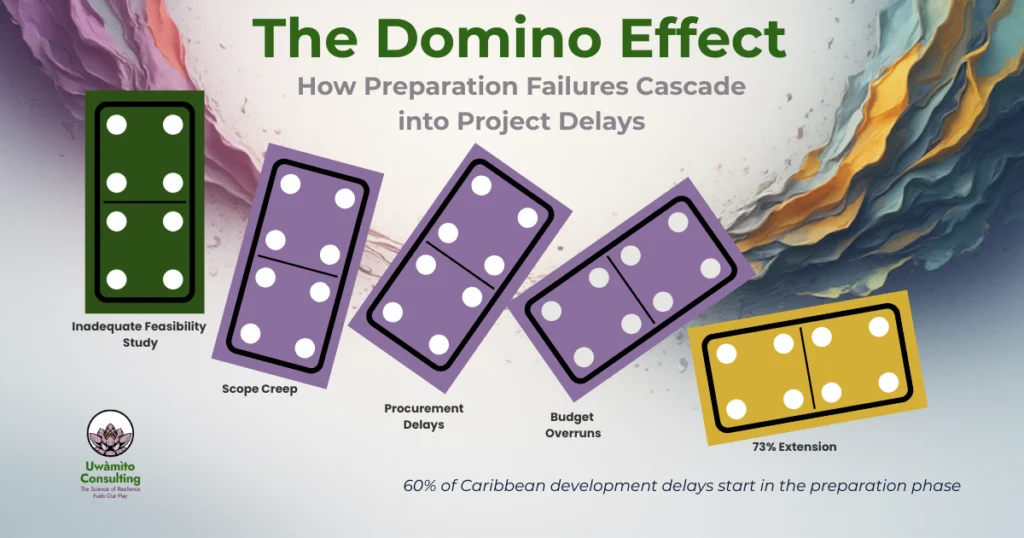
Research from the Caribbean Development Bank shows 70% of infrastructure projects face delays, with projects taking 73% longer than planned on average. The evidence reveals that 60% of delay drivers originate in the preparation phase. This article applies Implementation Science frameworks to diagnose why Caribbean projects struggle and offers practical, evidence-based solutions for governments, development finance institutions, and implementing organizations.
Jamaica lost 60% of its nursing cohort to overseas recruitment in 2023. Guyana loses 40% of engineering graduates by age 30, even during an oil boom when domestic opportunities have never been stronger. Over 70% of Caribbean nationals with tertiary education now live and work abroad.
Development reports classify these numbers as “brain drain” statistics requiring better retention policies or competitive salaries. But this framing misses the real crisis. When that Jamaican nurse emigrates to Canada, she takes more than her clinical skills. She takes the institutional knowledge of which community health protocols actually work in rural parishes, which stakeholder relationships enable cross-sector coordination, and which informal workarounds make formal systems function.
Research consistently demonstrates that organisations with strong learning cultures report 37% higher productivity than peers. When learning initiatives align with performance goals, performance improves by 95%. Yet only 34% of non-governmental organisation managers report that knowledge management is part of their organisational strategy.
Caribbean organisations lose critical implementation knowledge at rates that would be catastrophic in any other industry. This article examines why knowledge capture systems fail despite acknowledged importance, and presents three high-feasibility interventions that can interrupt the institutional amnesia cycle.
Most organizations treat annual reports as December compliance tasks. The best organizations use them as year-round learning systems. Research demonstrates organizations with systematic documentation reduce decision-making time by 30-40%

Across the Caribbean, government services are rapidly moving online in the name of efficiency. But when vulnerable citizens cannot navigate digital portals, we are not building modernisation. We are building new barriers. This analysis examines who gets left behind and what inclusive digital government actually requires.
The gap between strategy and implementation represents the single most expensive inefficiency in Caribbean development work today.

AI is a tool for empowerment, not replacement. As Caribbean leaders, we must embrace its potential while grounding our decisions in ethics, inclusion, and sustainability.